
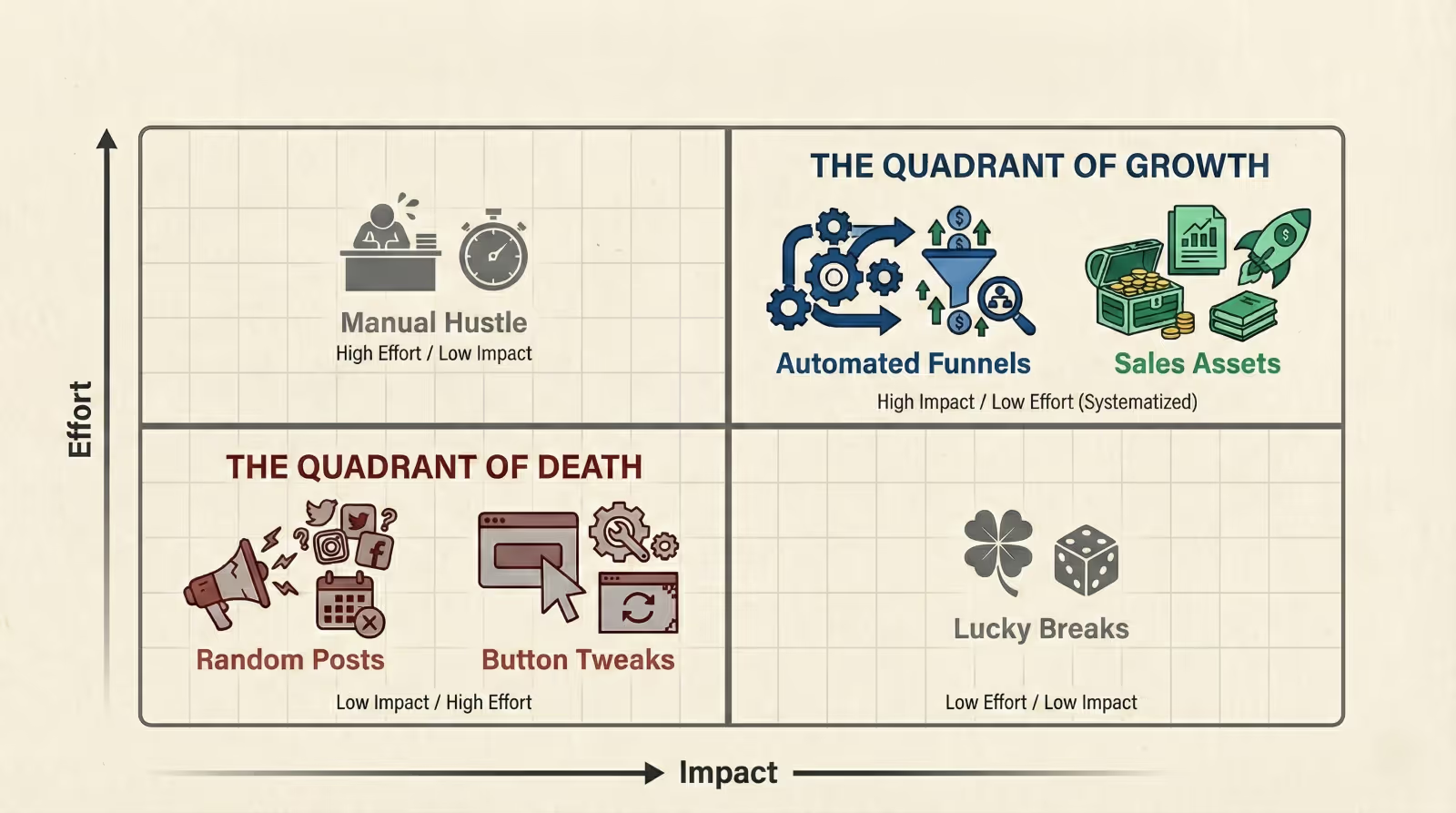
The Problem: Many B2B marketing teams suffer from "Random Acts of Marketing"—prioritizing urgent, low-value tasks (like social posts or color tweaks) over strategic initiatives. This creates a "Hamster Wheel" effect where the team is exhausted, but revenue stays flat.
The Insight: Activity does not equal Achievement. You cannot scale a business on fleeting activities; you can only scale on durable assets.
The Solution: Use the "Revenue vs. Noise" Matrix to audit your tasks. Shift focus from the "Quadrant of Death" (low impact/low durability) to the "Quadrant of Growth" (creating assets like lead magnets and nurture flows).
Walk into the marketing department of almost any B2B company doing €5M ARR, and you will see the same scene.
It is Monday morning. Keyboards are clacking. Slack notifications are pinging every few seconds. Tasks are moving across the Kanban board in Asana. The team is undeniably working hard.
But if you paused the room and asked the CEO a simple question, the energy would shift.
"How did the work done this week impact next month’s revenue?"
Most of the time, you would get silence. Or, you would hear vague answers about "brand awareness," "keeping the feed active," or "supporting sales."
This is the "Hamster Wheel" effect. Everyone is running, but the business isn't moving forward.
"Random Acts of Marketing" occur when a marketing team prioritizes urgency over strategy, focusing on disjointed tasks (like ad-hoc social posts or website tweaks) that lack a cohesive revenue goal. This approach creates high operational busyness but fails to build the durable assets required for scalable growth.
The result is a team that is burnt out, a CEO who is frustrated, and a pipeline that relies entirely on luck rather than engineering.
The biggest mistake Founders make is confusing "marketing activity" with "revenue engineering."
The Data is Clear: You cannot scale a business on Activity. You can only scale on Assets. According to Forrester, up to 70% of B2B content goes unused by sales teams because it is irrelevant. Conversely, companies that align their sales and marketing teams around a unified revenue strategy see 24% faster growth rates (SiriusDecisions).
The difference isn't effort. It's focus. If your marketing team stops working tomorrow, does your lead flow stop immediately? If "yes," you haven't built an engine; you've just hired people to manually push the car.
To fix the disconnect between effort and result, you must audit your focus. We use the "Revenue vs. Noise" Matrix, which evaluates tasks based on two axes: Revenue Impact (High vs. Low) and Durability (One-off vs. Evergreen).
Most teams spend 80% of their time in the wrong quadrant.
If you are a CEO or Marketing Leader feeling "operative stress," perform a calendar audit. Review the last two weeks of work and classify every task into one of the four quadrants. If less than 50% of time is in the "Quadrant of Growth," you are burning cash.
Let’s do the math. If you spend €200,000 a year on salaries, and 50% of the team's time is in the "Quadrant of Death," you aren't just wasting time. You are setting fire to €100,000 every year.
This is why we implement EnablementOS. Teams often want to do strategic work, but they lack the Operating System—the templates and playbooks—to say "No" to the noise.
To stop the bleeding, you need a filter. Before any new marketing task gets added to the backlog, force it through these three questions:
If the answer is "No," kill it or delegate it. Do not let your core talent spend their prime hours on it.
In our previous article, we discussed the "3-Person Revenue Engine"—the Architect, the Journalist, and the Promoter. This audit is how you manage them.
You don't need to hire more people to get more results. You often just need to stop doing the wrong things. Clear the calendar of "Random Acts" so your team has the space to build a Revenue Engine.
Marketing activity is temporary effort (e.g., sending an email, posting on social media) that stops generating value once the action is complete. Marketing assets are durable tools (e.g., an automated email sequence, a whitepaper, a comparison page) that continue to generate leads or revenue long after they are created.
Your team is likely stuck in the "Quadrant of Death" or "Admin Trap." They are prioritizing urgent, low-impact tasks like internal meetings, aesthetic tweaks, or manual follow-ups, rather than building scalable systems that generate demand automatically.
To stop Random Acts of Marketing, implement a "Focus Filter." Audit all tasks against a matrix of Revenue Impact vs. Durability. Reject tasks that don't educate buyers, support sales, or offer long-term value.