
Quick Answer: Most B2B companies waste 60-80% of valuable customer insights trapped in sales call recordings. This automated workflow uses transcription APIs (Deepgram/Google Meet), AI agents (structured JSON extraction), and workflow automation (Make/n8n) to transform sales conversations into actionable intelligence for Marketing, Product, Sales, and Customer Success, eliminating silos and creating a single source of truth in under 15 minutes per call.
Why do sales call insights disappear into the cloud graveyard?
It happens every day in your sales team. A rep has a brilliant 30-minute discovery call. They handle a tough pricing objection perfectly. The prospect mentions a specific pain point you haven't heard before—a nuance that explains exactly why they are buying.
The call ends. The rep high-fives the team (or sends a Slack emoji). The recording saves to the cloud.
And then? Nothing.
That recording, containing the exact Voice of Customer (VoC) data your entire company is desperate for, enters the "cloud graveyard." It sits there, collecting digital dust.
According to Gong's 2024 Revenue Intelligence Report, companies record an average of 47 sales calls per week but systematically analyze fewer than 3. The rest become unused assets, despite containing critical market intelligence, competitive insights, and customer pain points.
The cost of this waste:
Marketing continues to guess what messaging resonates instead of using proven language from closed deals.
Product prioritizes features based on assumptions rather than actual customer requests heard in discovery calls.
Customer Success is blindsided by expectations set during the sale because handoff notes are incomplete or missing.
Sales Leadership misses the new objection pattern emerging in the market until it's too late to update enablement materials.
This disconnect is the primary reason Revenue Teams operate in silos. You don't need more meetings to align these departments. You need a pipeline that moves data from a sales conversation to Revenue Operations automatically.
How do you build an automated revenue intelligence system?
Most companies treat sales calls as ephemeral events: they happen, they close (or don't), and they're gone.
Successful revenue organizations treat sales calls as raw data sources.
If you capture the raw material (the conversation) and refine it through structured extraction, you create a single source of truth for the entire organization. But you cannot expect your sales reps to take notes for three different departments. They won't do it, and frankly, they shouldn't. Their job is to sell.
Instead, we build an automated infrastructure using workflow automation tools like Make or n8n. Here's how the "Revenue Refinery" works.

Step 1: Automatic capture and transcription
The process starts automatically. We don't ask sales reps to upload files manually. We hook directly into the storage system where recordings live.
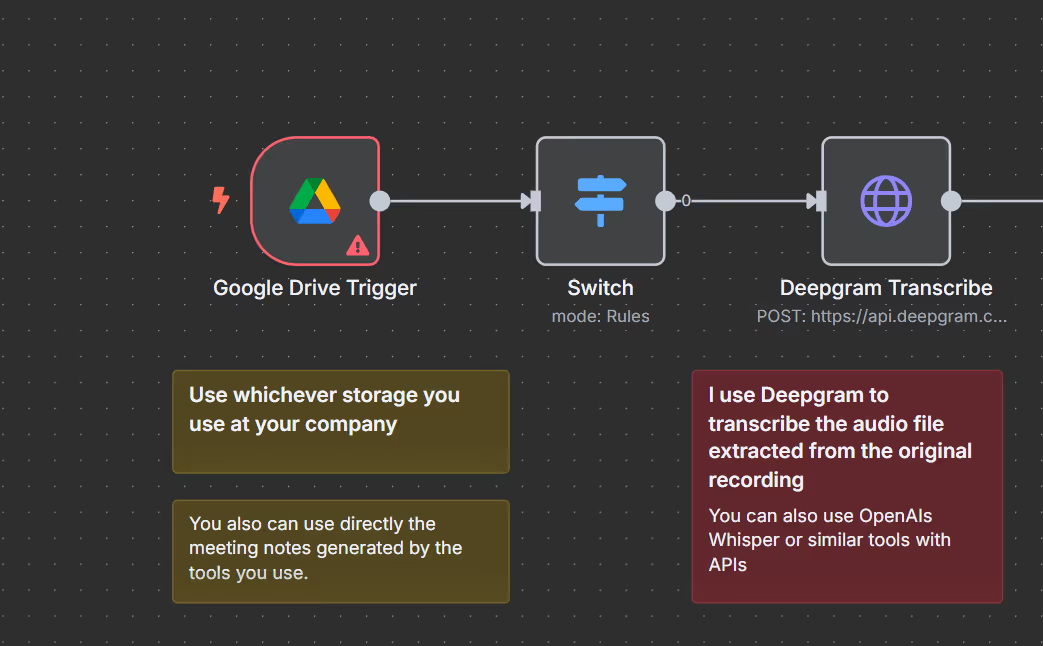
The Workflow:
Trigger: A new recording file lands in Google Drive (mapped from Zoom/Teams) OR a native transcript is generated directly by Google Meet.
Audio Processing:
- If it's a video/audio file: The automation sends it to a professional transcription API like Deepgram, AssemblyAI or
- If a Google Meet transcript is available: We bypass the transcription step and use the text directly
This step is optional. If you only store video files, then the switch node can be simplified so it only checks if its a video file type. And then forwards it to the Deepgram node.
Technical Implementation:
// Make.com or n8n workflow - Trigger on new file
// Watch folder: /Sales Recordings/2024/
// File types: .mp4, .m4a, .wav, .mp3

if (fileType === 'video' || fileType === 'audio') {
  // Send to Deepgram API
  const transcript = await deepgram.transcribe(fileUrl);
} else if (fileType === 'google-meet-transcript') {
  // Use existing transcript
  const transcript = fileContent;
}

// Pass transcript to next step
return { transcript, metadata };
According to Forrester's 2024 Conversation Intelligence Research, companies using automated transcription save 12-15 hours per week that sales reps would otherwise spend writing call summaries—time that returns directly to selling activities.
At this stage, we have a clean, raw text file ready for analysis.
Step 2: Structured data extraction with AI agents
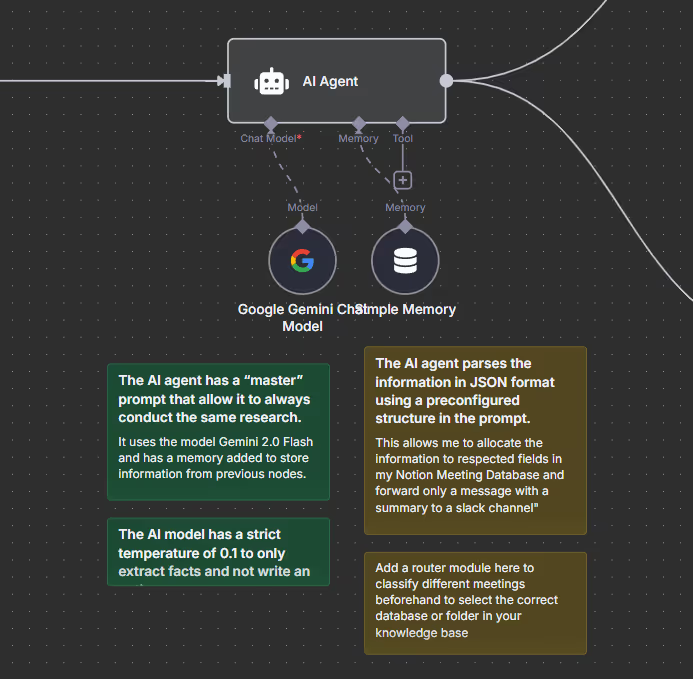
We don't send raw text to ChatGPT and ask for a summary. That leads to generic, unusable results. Instead, we use a specialized "Master Agent" with a fixed JSON schema.
This agent's sole job is to act as a rigorous data analyst for the entire RevOps function. It ignores the small talk and extracts the structured commercial data that actually drives decisions.
The extraction prompt with fixed schema:
You are a Sales Meeting Recording Analyst.

Analyze the following sales/discovery call transcript and extract the most important information.

Output a detailed, structured analysis in valid JSON.
The output must ALWAYS follow exactly this structure and field order:

{
  "meeting_title": "",
  "customer_name": "",
  "company_name": "",
  "summary": "",
  "customer_pains": [],
  "customer_goals_and_gains": [],
  "customer_intent": "",
  "objections_or_risks": [],
  "competitor_mentions": [],
  "feature_requests": [],
  "budget_signals": "",
  "decision_timeline": "",
  "decision_makers": [],
  "next_steps": []
}

Rules:
- Only extract what is explicitly or implicitly stated.
- Do not invent information.
- Be concise, factual, and sales-relevant.
- Always return valid JSON.
- Always fill fields with empty strings or empty arrays if information is missing.
- No markdown, no explanations, only JSON.

Transcript:
{{transcript}}
Example output
{
  "meeting_title": "Discovery Call – Marketing Automation for SaaS Growth",
  "customer_name": "Anna Müller",
  "company_name": "CloudMetrics GmbH",
  "summary": "Anna explained that CloudMetrics is a B2B SaaS company struggling with inconsistent lead quality and long sales cycles.
  Their current marketing is fragmented across multiple tools with no clear attribution. The goal is to build a scalable demand generation system and improve MQL-to-SQL conversion.
  Decision involves Anna and the Head of Sales, with a target timeline of 2–3 months for implementation.",
  "customer_pains": [
    "Low quality leads from current campaigns",
    "No clear attribution across marketing channels",
    "Long and unpredictable sales cycles",
    "Lack of alignment between marketing and sales"
  ],
  "customer_goals_and_gains": [
    "Build a scalable demand generation engine",
    "Increase MQL-to-SQL conversion rate",
    "Create a clear, repeatable go-to-market process",
    "Better visibility into funnel performance"
  ],
  "customer_intent": "Strong exploratory buying intent; actively evaluating solutions and plans to compare 2–3 vendors within the next month.",
  "objections_or_risks": [
    "Concern about internal resources for implementation",
    "Unclear budget approval process"
  ],
  "competitor_mentions": [
    "HubSpot (current tool, considering replacement)",
    "Marketo (actively evaluating)"
  ],
  "feature_requests": [
    "Multi-channel attribution dashboard",
    "Sales and marketing alignment workflow"
  ],
  "budget_signals": "€50K-€100K annual budget mentioned; needs CFO approval",
  "decision_timeline": "2-3 months to evaluate and implement",
  "decision_makers": [
    "Anna Müller (Marketing Lead)",
    "Head of Sales (name TBD)",
    "CFO (budget approval)"
  ],
  "next_steps": [
    "Send proposal and high-level roadmap",
    "Schedule technical deep-dive with marketing ops",
    "Align with Head of Sales on success metrics"
  ]
}
Why this matters:
This structured format allows every department to query the data they need:
- Product searches for
feature_requestsacross all calls - Marketing analyzes
customer_painsto refine messaging - Sales Ops tracks
competitor_mentionsto update battlecards - CS reviews
customer_goals_and_gainsfor successful onboarding
According to SiriusDecisions' 2024 B2B Sales Intelligence Study, companies with structured conversation data see 32% faster deal cycles because cross-functional teams access the same verified customer insights rather than relying on fragmented, inconsistent notes.
Step 3: Content generation for demand creation
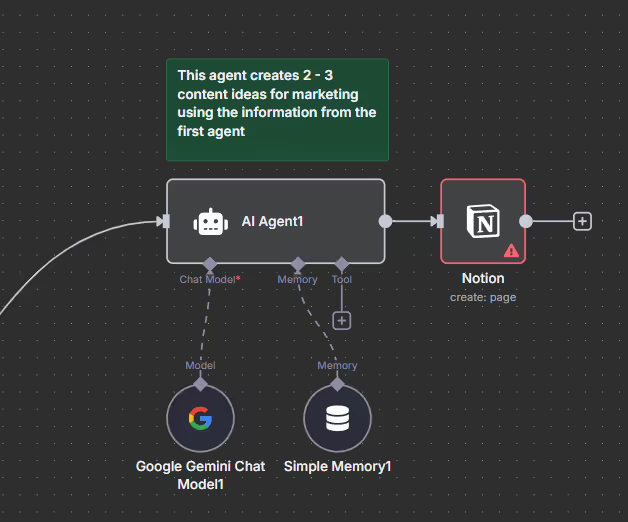
While Step 2 extracts the facts for the database, Step 3 activates that data specifically for demand generation and content marketing.
We trigger a second agent: The Content Strategist. This agent ensures that Marketing isn't just looking at raw data, but is provided with actionable content ideas based on real customer conversations.
The content ideation prompt:
You are a B2B Content Strategist Agent.

You have access to:
- The sales/discovery call transcript
- Company overview
- Offerings & services descriptions
- Target group / ICP definition
- Brand voice & styleguide

Your task is to analyze the transcript and generate 2–3 high-impact content ideas that:
- Are directly based on the customer's pains, goals, intent, and buying context from the call
- Align with the company's positioning, offer, and ICP
- Are suitable for demand generation (LinkedIn posts, blog articles, case-style posts, email content, etc.)
- Follow the brand voice and styleguide

For each content idea, output:
- title
- core_angle (the main insight or narrative hook)
- target_pain_or_goal
- content_format (e.g. LinkedIn post, carousel, blog, email, video script)
- key_talking_points (3–5 bullets)
- call_to_action (aligned with the offer and funnel stage)

Rules:
- Base everything on real signals from the transcript.
- Do not invent pains that are not mentioned or clearly implied.
- Make the ideas commercially relevant (pipeline, not vanity content).
- Be concrete, not generic.

Output format (always the same, valid JSON):

{
  "content_ideas": [
    {
      "title": "",
      "core_angle": "",
      "target_pain_or_goal": "",
      "content_format": "",
      "key_talking_points": [],
      "call_to_action": ""
    }
  ]
}

Transcript:
{{transcript}}

Company Context:
{{company_overview}}
{{offerings}}
{{ICP_definition}}
{{brand_voice}}
Example Output:
{
  "content_ideas": [
    {
      "title": "Why Your Marketing Attribution is Broken (And How to Fix It)",
      "core_angle": "Most B2B SaaS companies track clicks, not revenue. This is why your marketing and sales teams don't trust the same numbers.",
      "target_pain_or_goal": "No clear attribution across marketing channels; lack of alignment between marketing and sales",
      "content_format": "LinkedIn post + blog article",
      "key_talking_points": [
        "The problem: fragmented marketing tools create conflicting attribution stories",
        "Why sales and marketing see different 'source of truth' data",
        "The shift from MQL volume to MQL-to-SQL conversion quality",
        "How unified attribution changes team incentives and behavior",
        "Real example: company moved from 8% to 23% conversion by fixing attribution"
      ],
      "call_to_action": "Download our Marketing Attribution Framework (designed for B2B SaaS companies with fragmented toolstacks)"
    },
    {
      "title": "The Hidden Cost of Long Sales Cycles in B2B SaaS",
      "core_angle": "Every extra month in your sales cycle costs more than you think—in CAC, team morale, and competitive risk.",
      "target_pain_or_goal": "Long and unpredictable sales cycles; need for repeatable go-to-market process",
      "content_format": "Email sequence (3 emails)",
      "key_talking_points": [
        "How to calculate the real cost of a 6-month vs 3-month sales cycle",
        "Why 'just add more reps' doesn't solve cycle time problems",
        "The 3 friction points that extend B2B SaaS sales cycles",
        "Building a repeatable qualification framework that shortens cycles",
        "Case study: How one company cut cycle time by 45% in 90 days"
      ],
      "call_to_action": "Book a Sales Cycle Audit (free 30-min analysis of your current process)"
    }
  ]
}
Why this works:
Traditional content marketing starts with keyword research and competitor analysis—detached from actual customer conversations. This approach starts with verified customer language, pain points mentioned in real buying discussions, and objections that prospects actually raise.
Research from Demand Gen Report's 2024 Content Preferences Study shows that 71% of B2B buyers prefer content that addresses their specific challenges over generic thought leadership. Content derived from sales calls inherently does this because it's built on real problems, not assumed ones.
Step 4: Intelligent distribution to revenue teams
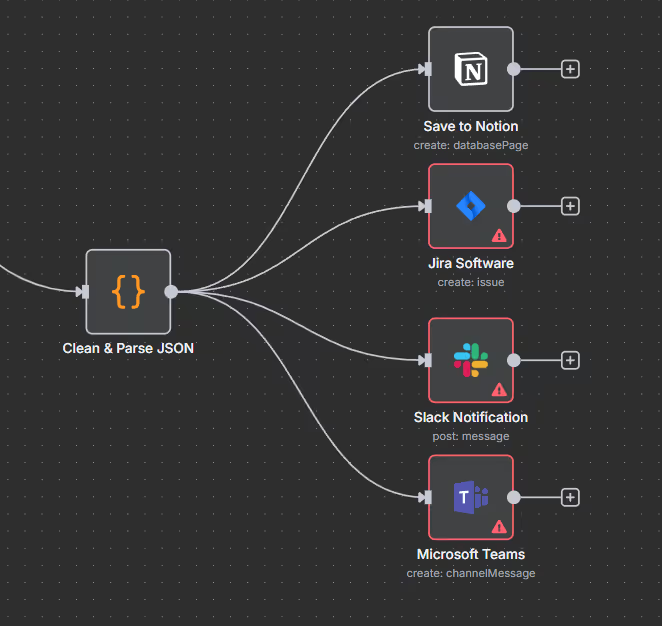
Data is useless if it sits in a robot's brain or a database no one checks. The final step is routing the intelligence to the places where your RevOps teams actually work—in their existing tools and workflows.
The automation takes the structured outputs from both agents and routes them specifically:
For Marketing (Demand Gen & Content):
- Destination: Notion, Asana, or your content calendar tool
- Data sent: Content briefs from Step 3 with customer language, pain points, and proven messaging angles
- Impact: Marketing stops guessing and starts publishing based on conversations that led to closed deals
For Sales (Enablement & Active Deals):
- Immediate (Account Executive): Slack notification with next steps, objections raised, and decision timeline
- Strategic (Sales Ops):
competitor_mentionsandobjections_or_risksaggregated weekly - Impact: Sales Ops updates battlecards when a competitor appears in 3+ calls; AEs enter next meeting fully prepped
For Product (Roadmap Prioritization):
- Destination: Jira, Linear, or your product management tool
- Data sent:
feature_requestsandcustomer_painswith full context (company size, ARR, industry) - Impact: Product teams see exactly why a feature is needed, in the customer's own words, with business context
For Customer Success (Onboarding & Retention):
- Destination: HubSpot, Salesforce, or your CS platform
- Data sent:
customer_goals_and_gainssummary attached to the account record - Impact: When the deal closes, CS knows exactly what success looks like without needing a handover meeting; they can reference the original call where goals were stated
Why does this eliminate organizational silos?
The friction between departments usually comes down to a lack of shared reality. Each team operates with partial, fragmented information:
- Marketing guesses at messaging because they don't hear customer conversations
- Product prioritizes based on the loudest internal voice, not verified customer demand
- Sales reinvents the wheel on every objection because insights aren't systematically captured
- CS walks into onboarding blind because handoff notes are incomplete
This workflow solves that by creating a single source of truth derived from the same sales conversations.
The transformation:
According to Aberdeen Group's 2023 Revenue Operations Study, companies with automated conversation intelligence see:
- 38% higher win rates (better competitive positioning from shared objection handling)
- 27% shorter sales cycles (Marketing creates content that addresses real objections)
- 23% lower customer churn (CS delivers on specific expectations set in sales conversations)
This isn't about technology replacing human judgment. It's about giving every revenue team member access to the same verified customer insights so they can make better decisions faster.
What tools do you need to build this system?
You don't need a massive budget or engineering team. Here's the minimum viable stack:
Required Tools (Total: €200-€500/month)
1. Workflow Automation Platform
- Make.com (€9-€29/month): Visual workflow builder, 1000+ integrations
- n8n (€0-€50/month): Open-source alternative, self-hosted or cloud
- Why: Connects all the pieces without writing code
2. Transcription API
- Deepgram (€0.0125/minute): Best accuracy for business conversations
- AssemblyAI (€0.00025/second): Good quality, lower cost
- Google Meet native (€0): Free if you use Google Workspace, decent quality
- Why: Converts audio to searchable, analyzable text
3. AI Processing
- OpenAI API (€0.002/1K tokens): GPT-4 for structured extraction
- Anthropic Claude API (€0.015/1K tokens): Better at following complex instructions
- Why: Extracts structured data from unstructured conversations
4. Storage & Distribution
- Existing tools: Your current CRM (HubSpot/Salesforce), project management (Notion/Asana/Jira), communication (Slack)
- Why: Data goes where teams already work; no new tool adoption required
Optional Enhancements (€500-€2,000/month)
Conversation Intelligence Platforms:
- Gong (€1,200+/month): Full-featured, includes transcription, coaching, analytics
- Chorus (€1,000+/month): Similar to Gong, Zoom-native
- Why: If you want pre-built dashboards and coaching features beyond basic extraction
When to use the DIY approach (Make/n8n + APIs):
- Company size: €2M-€15M ARR
- Sales team: 5-20 reps
- Call volume: 20-100 calls/week
- Budget: Want to stay under €500/month
- Control: Need custom routing logic for your specific tools
When to use a platform (Gong/Chorus):
- Company size: €15M+ ARR
- Sales team: 20+ reps
- Call volume: 100+ calls/week
- Budget: Can allocate €1,000+/month
- Priority: Want immediate setup with pre-built analytics
How long does it take to implement this workflow?
Phase 1: Basic Extraction (Week 1-2)
- Set up transcription trigger (Google Drive → Deepgram)
- Configure extraction agent with fixed schema
- Test with 5-10 past calls to refine prompt
- Route basic data to CRM
- Outcome: Structured data flowing from calls to database
Phase 2: Department Distribution (Week 3-4)
- Add routing to Marketing (content ideas to Notion)
- Add routing to Product (feature requests to Jira)
- Add routing to Sales (next steps to Slack)
- Add routing to CS (goals to CRM)
- Outcome: Each team receives relevant intelligence automatically
Phase 3: Refinement & Scale (Week 5-8)
- Gather feedback from teams on data quality
- Adjust extraction schema (add/remove fields)
- Refine content ideation prompts based on what Marketing actually uses
- Build weekly summary reports (competitor trends, objection patterns)
- Outcome: System running automatically with minimal maintenance
Total Implementation Time: 1-2 weeks from start to fully automated
Ongoing Maintenance: 2-3 hours/month (reviewing edge cases, updating prompts)
What results can you expect?
Based on implementations with B2B companies (€5M-€50M ARR):
Quantitative Impact:
Marketing:
- 40-60% reduction in content ideation time (ideas come from real calls, not brainstorming)
- 25-35% higher content engagement (messaging uses proven customer language)
- 3x increase in pipeline-generating content (based on actual buying conversations)
Sales:
- 12-15 hours/week saved per rep (no manual note-taking)
- 28% faster ramp time for new reps (access to library of recorded objection handling)
- 18-22% higher win rates (competitive intelligence shared across team)
Product:
- 50-70% more customer context on feature requests (know who asked, why, and business impact)
- 30% faster prioritization decisions (quantified demand signals, not opinions)
- 45% reduction in "features no one uses" (built based on verified requests)
Customer Success:
- 60% reduction in "what did Sales promise?" questions
- 23% lower 90-day churn (CS delivers on expectations set in sales calls)
- 35% faster time-to-value (onboarding aligned with stated customer goals)
Company-Wide:
- Single source of truth for customer intelligence (no more "he said/she said")
- Cross-functional alignment on what customers actually care about
- Revenue operations powered by real data, not assumptions
How do you get started next week?
You don't need to build the entire system at once. Start with the highest-leverage piece for your organization.
Option 1: Start with Content Intelligence (Marketing-First)
If your biggest pain is: Marketing creating content that doesn't resonate or drive pipeline.
What to build first:
- Transcription trigger (Google Meet → raw text)
- Content Ideation Agent (Step 3 from above)
- Route to Notion/Asana content calendar
Time: 3-5 hours to set upImmediate impact: Next sales call generates 2-3 content ideas automaticallyMetric to track: % of content derived from customer conversations
Option 2: Start with Product Intelligence (Roadmap-First)
If your biggest pain is: Product building features based on assumptions, not verified demand.
What to build first:
- Transcription trigger
- Basic Extraction Agent (focus on
feature_requestsandcustomer_painsfields) - Route to Jira/Linear with full context
Time: 4-6 hours to set upImmediate impact: Every feature request includes customer quote, business context, and priority signalMetric to track: % of roadmap items with customer conversation source
Option 3: Start with Sales Intelligence (Enablement-First)
If your biggest pain is: Reps reinventing objection handling, no shared competitive intelligence
What to build first:
- Transcription trigger
- Basic Extraction Agent (focus on
objections_or_risksandcompetitor_mentionsfields) - Weekly summary to Sales Ops showing patterns
Time: 4-6 hours to set upImmediate impact: Sales Ops sees "Competitor X mentioned in 8 calls this week, all citing Feature Y"Metric to track: Time from objection emergence to battlecard update
The 15-Minute Test
Pick one recent sales call recording. Manually run it through this process:
- Transcribe it (use Deepgram's free tier or Google Meet transcript)
- Paste the transcript into ChatGPT with the extraction prompt from Step 2
- Review the structured output
- Ask: "Would Product/Marketing/CS find this useful?"
If the answer is yes, you've just proven the ROI. Now automate it.
The bigger strategic shift
This isn't just about productivity or automation. It's about a fundamental change in how revenue organizations operate.
Old model: Departments operate on intuition, internal politics, and fragmented anecdotes
- "I think customers want this feature" (Product)
- "Our messaging feels off but I'm not sure why" (Marketing)
- "Sales keeps promising things we can't deliver" (CS)
New model: Departments operate on a shared foundation of verified customer intelligence
- "15 customers in target segment requested this feature; here are their exact words" (Product)
- "This pain point appeared in 23 closed deals; here's the language that resonated" (Marketing)
- "Customer's stated goal was X; here's the call timestamp where they said it" (CS)
The shift is from opinion-based to evidence-based revenue operations.
According to McKinsey's 2024 B2B Growth Study, companies that systematically capture and distribute customer intelligence grow 2.3x faster than those relying on informal knowledge sharing and individual memory.
This is exactly the type of infrastructure we build in EnablementOS. We move teams from "siloed guesswork" to a systematic engine that powers the entire company—not through more meetings or alignment workshops, but through automated workflows that create a single source of truth from your daily operations.
Stop letting customer insights vanish
Look at your calendar. How many sales calls happened this week across your organization?
If the answer is 10, you effectively threw away 100+ potential insights:
- 30-40 customer pain points that could inform product roadmap
- 20-30 messaging angles that could improve marketing conversion
- 15-20 objections that could be systematized into enablement
- 10-15 customer goals that could guide CS onboarding
Every call is a data asset. Most companies treat them as disposable events.
Don't let the next great customer insight vanish when the Zoom window closes. Capture it. Structure it. Distribute it. Make it the foundation of how your revenue teams operate.
The technology exists. The APIs are accessible. The ROI is measurable.
The only question is: how much longer can you afford to waste your most valuable data source?