

Executive Summary (TL;DR)
Most B2B CEOs between €4M and €10M in revenue face a common wall: they have a marketing team but lack a marketing machine. This results in reactive, inconsistent activity that depends on external agencies or founder-led efforts. The Enablement OS is a 90-day framework designed to build this missing infrastructure internally.
The system consists of three specific phases:
- Alignment: We fix fuzzy positioning to ensure Sales and Marketing speak the same language.
- Enablement: We install the processes, templates, and roles required for consistent execution.
- Optimization: We build a data dashboard that tracks revenue truth instead of vanity metrics.
By the end of 90 days, your company stops renting growth and starts operating a predictable, internal revenue engine.
Why €4M–€10M scale-ups hit a growth wall and the exact operating system you need to break through
You have a product that works. You have reached €4 million, perhaps €8 million, in annual revenue based on the strength of that product, founder-led sales, and referrals. You have a sales goal that demands double-digit growth next year. You might even have a marketing team: a Head of Marketing and a working student, or perhaps a small pod of specialists.
But you do not have a machine, a clear foundation and strategy in place.
Instead, you have activity. Your marketing feels reactive, frantic, and disconnected from revenue. One month, the focus is a trade show. Next, you panic because LinkedIn isn’t working. The month after that, you are hiring an agency to run ads because the pipeline is empty.
There is no red thread. There is no guidance system that connects your high-level business goals to the daily tasks your team executes.
This is the Operational Void.
Most CEOs in the €4M to €10M range try to fill this void in one of two ways:
- The Agency Trap: They hire a performance marketing agency to turn on the faucet. This works for three months until the cost-per-lead spikes, lead quality drops, and you realize you are renting growth, not owning it.
- The Unicorn Hunt: They try to hire a Head of Growth who can write copy, manage ads, design graphics, and build strategy simultaneously. This person does not exist.
The problem is not that your team is incapable. The problem is not that agencies are bad. The problem is that you are trying to run a high-performance engine in a chassis built for a hobby project.
You do not need more creative ideas, not more leads, but simply an operating system.
We call this system EnablementOS. It is the infrastructure that turns marketing from a cost center into a predictable, agency-independent revenue engine.
We are not going to spend time explaining why you need it. Instead, we are going to show you exactly how to build it. This is the 90-day framework we use to install this system for B2B tech and consulting companies.
The Model: Installing the Infrastructure
B2B companies view marketing as a linear list of tasks: Write a blog, post on LinkedIn, send an email, and get a lead.
EnablementOS is not a line: it is a feedback loop. It is a triangular structure that requires three distinct elements to function:
- The Compass (Alignment and Strategy): Defining the Radical Truth of who you target and what pain you solve. Without this, speed is irrelevant because you are running in the wrong direction.
- The Engine (Enablement and Build): The SOPs, playbooks, and workflows that allow your team to execute consistently without you hovering over them.
- The Dashboard (Optimization and Handoff): The data layer that tells you what is working, stripping away vanity metrics in favor of revenue truth.
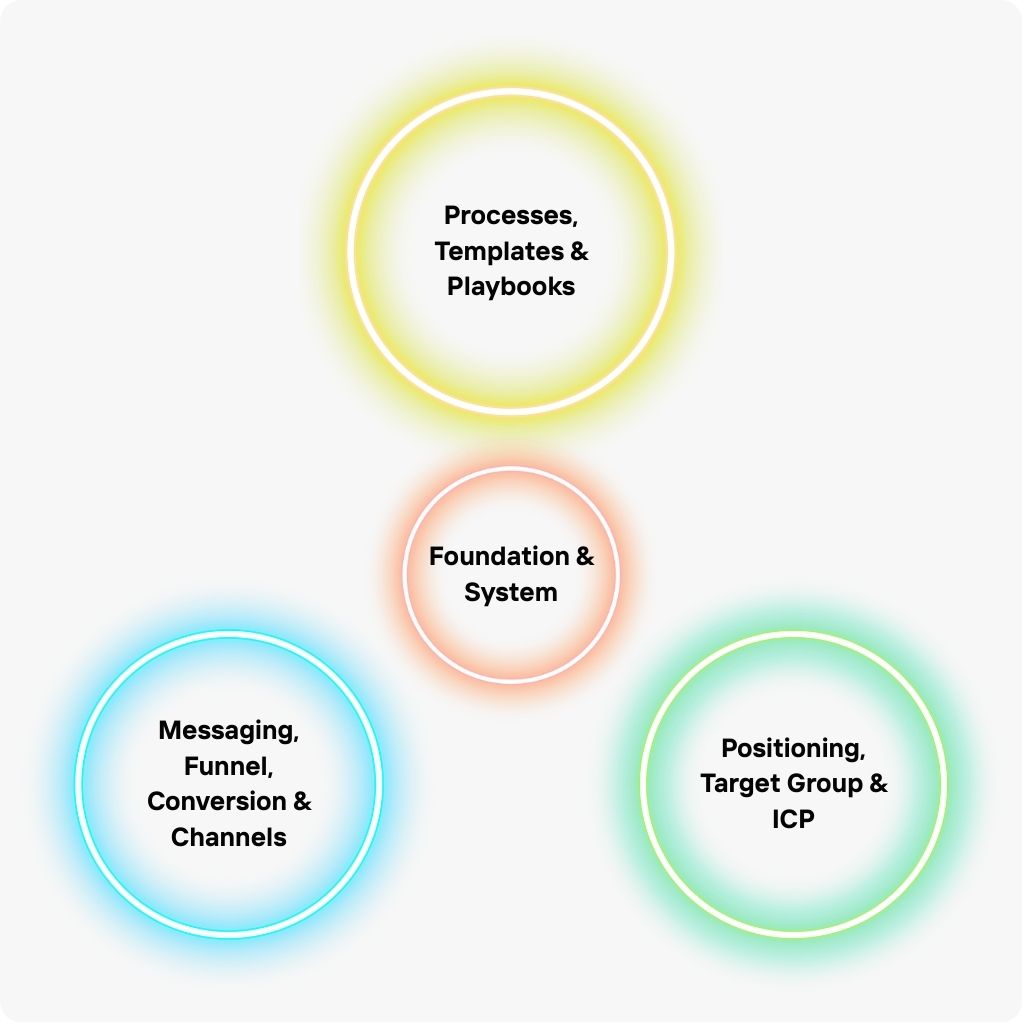
In 90 days, we do not just improve your marketing. We install these three components permanently into your business. Here is the roadmap.
Phase 1: Alignment and Strategy (The Compass)
Days 1–30
The most expensive mistake B2B companies make is having “Fuzzy Positioning”.
Fuzzy Positioning happens when your Sales team sells one thing, your website says another, and your product team builds a third.
- Sales says: We offer a custom consulting solution for logistics efficiency.
- Marketing says: We are the leading provider of supply chain AI software.
- The Market hears: Static.
If you run ads on top of unclear Positioning, you are simply paying to amplify confusion. Before we write a single line of copy or launch a single campaign, you must build your Truth Architecture.
Step 1: The Radical Truth Audit
We stop all new initiatives. We pause the panic. We look at the data to see where the money is actually leaking.
Most audits are superficial checks of ad account settings. We go deeper. We audit the logic of your business.
- The CRM Audit: We look at your Closed-Lost reasons. Are leads irrelevant? Are they too small? Or did they ghost you? If 90% of your MQLs (Marketing Qualified Leads) never turn into SQLs (Sales Qualified Leads), or Opportunities your marketing is effectively burning cash (and sales is not happy, Marketing and Sales aren't aligned).
- The Content Audit: We analyze your last 20 pieces of content. Did they educate the buyer, or did they just brag about your features? If your content is all "We are great," you have no trust and your Target Group doesn't care.
- The Messaging Audit: We apply the 3-Second Rule to your homepage. If a stranger cannot tell us what pain you solve in 3 seconds, you have failed.
Step 2: Stakeholder Interrogation
This is where the cracks in the foundation become visible. We conduct separate, confidential interviews with the CEO, the Head of Sales, and the Head of Marketing.
We ask them the same three questions:
- Describe your Ideal Customer Profile (ICP) in one sentence.
- What is the primary reason we lose deals?
- What is the definition of a qualified lead?
In 90% of companies, we get three different answers.
- CEO: We target Enterprise logistics firms.
- Marketing: We target anyone in logistics with over 50 employees.
- Sales: We target the Logistics Director at firms with €50M+ revenue who uses SAP.
This misalignment is why your pipeline is unpredictable. Marketing is hunting rabbits while Sales is set up to catch bears.
The Fix: We force alignment. We workshop these definitions until everyone agrees on a single document: The Source of Truth. This document defines the ICP, the buying triggers, and the exact criteria for an MQL and SQL.
Step 3: The Positioning Pillar
Once we agree on who we are targeting, we define what we are saying.
We strip away the corporate jargon. No more "synergistic solutions." No more "innovation-driven partners." We build a Messaging Framework based on pains, gains and "Jobs to be done (JTBD)"
This framework includes:
- The Old Way vs. The New Way: How the customer tries to solve the problem today, and fails, versus how they will solve it with you.
- The Value Proposition Canvas: Specific messaging for each persona. The CFO needs to hear about cost reduction. The CTO needs to hear about integration security.
- The Anti-Pitch: Why should they not buy from you? Defining this builds immense credibility.
Phase 1 Deliverable: You are no longer guessing. You have a Truth Architecture: a strategic roadmap that aligns your entire revenue team. You know exactly who you are targeting and exactly what to say to them.
Phase 2: Enablement and Build (The Engine)
Days 31–60
Strategy without execution is just a theory.
Phase 1 gave us the map. Phase 2 builds the vehicle. This is where the Enablement happens. We do not want to be your agency forever. We want to build the infrastructure so your team can run it themselves.
The goal here is consistency. Most marketing teams rely on Hero Mode: one person working late nights to get a newsletter out. That is not a system. A system runs regardless of who is in the office.
Step 1: Installing the 3-Role Structure
You do not need a team of 10 people to reach €10M. You need three specific functions covered. Often, one person, your Marketing Lead, tries to do all three, which is why they fail.
We help you structure the team or the roles for your existing team into:
- The Strategist: Owns the message, the offer, and the data. They decide what to say.
- The Creator: Turns the message into assets like video, text, and design. They decide how it looks.
- The Distributor: Gets the assets in front of the right eyes via Ads, LinkedIn, or Email. They decide where it goes.
If you lack one of these roles, we help you hire freelancers or structure your current team to cover the gap (or we stay inhouse for a while).
Step 2: The Content Engine (Demand Creation)
Most B2B companies confuse Demand Capture with Demand Creation.
- Demand Capture: Ads that say "Buy Now" or "Book a Demo." These only work on the 3% of the market actively looking to buy.
- Demand Creation: Content that educates the 97% who are not ready to buy yet, so that when they are ready, you are the only logical choice.
We install a Content Engine that produces high-quality thought leadership without requiring the CEO to write for 10 hours a week.
The Subject Matter Expert (SME) Interview Workflow: We set up a process where your Marketing Creator interviews your technical experts or leadership once a month for 60 minutes. From that one recording, we build a Content Waterfall:
- 1 Long-form Article (or podcast, video) as the anchor piece.
- (1 Article from video/podcast for your website)
- 5 LinkedIn Posts using snippets and insights.
- 1 Newsletter for direct distribution.
- 3 Short-form Videos if applicable.
We create the Templates and SOPs for this. Your team does not have to invent the format every time. They just fill the container.
Step 3: The Distribution System
Posting on LinkedIn is not a distribution strategy. It is posting and praying.
We build a structured distribution playbook.
- The Zero-Click Rule: We teach your team how to write content that gives value on the platform, whether LinkedIn or Email, without forcing a click. This builds trust.
- Paid Amplification: We set up the ad accounts not to sell, but to distribute content. We use paid social to ensure your Ideal Customer Profile sees your best educational articles.
- The Nurture Sequence: We build the email flows that happen after someone downloads a lead magnet. Not a generic "Thanks for downloading," but a 5-part sequence that adds further value and handles objections.
Step 4: The Conversion Layer (Demand Capture)
Now that we are creating demand, we need a mechanism to capture it.
We overhaul your conversion points.
- Landing Page Optimization: We rewrite your core pages using the messaging from Phase 1. We remove the fluff. We focus on the Job to be Done.
- The High-Intent Offer: "Contact Us" is a weak Call to Action (CTA). We create specific offers like "Get a Strategy Audit" or "Pricing Calculator" that give the prospect a reason to raise their hand.
Phase 2 Deliverable: A functioning marketing machine. Your team has the Playbooks and SOPs to create, distribute, and convert. They are no longer improvising. They are executing a documented process.
Phase 3: Optimization and Handoff (The Dashboard)
Days 61–90
Now the engine is running. The final phase is teaching you how to drive it.
The biggest enemy of a CEO is vanity metrics. Agencies love vanity metrics. They will send you a report saying: "We got 100,000 impressions and 500 clicks! Great success!"
But if those 500 clicks resulted in zero revenue, the report is not useful.
In Phase 3, we install the Feedback Loop that connects marketing activity to bank account reality.
Step 1: The Truth Dashboard
We kill the PDF reports. We build a live dashboard using tools like Looker Studio, Databox, or HubSpot that tracks only what matters.
The Revenue Metrics We Track:
- Pipeline Velocity: How fast are deals moving?
- CAC (Customer Acquisition Cost): How much does it cost to acquire a customer, not just a click?
- Lead-to-Opportunity Rate: Are the leads actually qualified?
- Source Attribution: Which specific article or ad brought in the big deal?
We teach your team that Likes are for ego while Demos booked are for revenue.
Step 2: Sales and Marketing Alignment (The Feedback Loop)
This is the most important operational ritual we install: The Bi-Weekly Growth Meeting.
Most companies have Sales meetings and Marketing meetings. They rarely talk. We instigate a joint meeting with a strict agenda:
- Marketing asks Sales: We sent you 10 leads last week. 3 were bad. Why? What did they say? What objection stopped them?
- Sales asks Marketing: I have a prospect stalling on price. Do we have a case study about ROI I can send them?
This feedback loop is the Optimization in Enablement OS.
- If Sales says leads are price-sensitive, Marketing adjusts the messaging to emphasize value.
- If Marketing sees high engagement on a specific topic, Sales uses that topic in their outreach.
The wall between departments comes down. They become one Revenue Team.
Step 3: The First Win Campaign
We do not just build the car and walk away. We drive the first lap with you.
Together with your team, we launch the first full campaign using the new OS.
- We select the topic based on Phase 1 strategy.
- We create the assets using Phase 2 templates.
- We measure the results using Phase 3 dashboards.
Your team watches us do it, then they help do it, then they do it themselves. This is learning by doing.
Step 4: Handover and Independence
By Day 90, the training wheels come off.
We ensure:
- Your Knowledge Base is complete. Every process is documented in Notion, Miro, or your internal wiki.
- Your Tech Stack: CRM, Automation, Analytics: is clean and integrated.
- Your Team knows the difference between a tactic and a strategy.
Phase 3 Deliverable: Predictability. You have a dashboard that tells the truth. You have a team that understands the reasoning behind their tasks. You have a system that improves itself through feedback loops.
The Maturity Gap: Why Your Team Cannot Just Figure It Out
We often hear CEOs say: Why can't my current Marketing Manager just do this? Why do I need Enablement OS?
This is the Maturity Gap.
Your Marketing Manager is likely talented. They are hardworking. They are loyal. But they are likely an Executor, not an Architect.
They are stuck in the trenches of daily production: writing social posts, fixing website bugs, and organizing events. They do not have the time, nor the experience, to step back and build a €10M revenue infrastructure. They have likely never seen one before.
Asking them to build this system while running daily operations is like asking a pilot to repair the engine while flying the plane.
Enablement OS bridges this gap.
It gives your team the structure they need. Good marketers want systems. They want to know that their work is driving revenue. They are tired of guessing.
By installing this OS, you are not replacing your team: you are upskilling them. You are turning them from Task Managers into Revenue Drivers. You are giving them the tools to succeed.
The Agency Trap vs. The Internal Asset
Let’s look at the financials.
Option A: The Agency Retainer
- Cost: €5,000–€10,000 per month.
- Model: Renting attention.
- Asset: None. The moment you stop paying, the knowledge leaves the building. The leads stop. You are back to zero.
- Result: Dependency.
Option B: The EnablementOS
- Cost: A fixed investment.
- Model: Building infrastructure.
- Asset: Permanent. You own the strategy. You own the playbooks. You own the data. Your team owns the capability.
- Result: Independence.
In the long run, building internal capability is the only way to scale profitably. You cannot outsource your core competency. If acquiring customers is vital to your business, and it is, you must own the system that does it. Read a deep dive on inhouse vs agency.
You can calculate your costs here and compare it: Agency vs. Inhouse Calculator.
Stop Guessing. Start Building.
You have spent enough time hoping that the next hire or the next agency will be the magic solution.
There are no magic solutions in B2B growth. There is only process, consistency, and data.
If you are a CEO of a Tech or Consulting scale-up in the €4M to €10M range and you are tired of the chaos: if you want to look at your marketing pipeline and feel confidence rather than anxiety: it is time to install the Operating System.
We do not do the marketing for you. We build the machine with you, so you never have to depend on an outsider again.
Ready to see if your team can handle the OS?
We offer a System Audit to qualified companies. We will look at your current structure, your data, and your positioning, and tell you exactly where the Operational Void is holding you back.
Frequently asked questions: Common Questions about Enablement OS
How much time does the CEO need to commit?
Your time is your most important resource, so we focus on high leverage. In Phase 1 (Diagnosis), we need about 4 to 6 hours of your focused attention to extract the Radical Truth and approve the strategy. In Phases 2 and 3, your involvement drops to 1 to 2 hours per month for high-level review. We work primarily with your Marketing Lead and Sales Lead.
What if my team is too junior?
The Enablement in Enablement OS is designed exactly for this. We provide the templates, the checklists, and the coaching. A junior team with a great system will outperform a senior expert with no system every time. If your team is too small, for example, just one intern, we will help you draft the job description for your next key hire.
Is this just a consulting deck?
No. Strategy decks collect dust. We build living assets. We set up the actual software. We write the actual first campaign. We build the actual dashboard. You walk away with a functioning machine, not a PDF.
How is this different from a Fractional CMO?
A Fractional CMO often becomes a perpetual retainer: another salary on your books. Our goal is to make ourselves obsolete in 90 days. We come in, build the system, train your team to run it, and leave. We are architects, not tenants.
What is the guaranteed tangible outcome we receive on Day 91?
While we cannot guarantee lead volume (as that depends on market, product, and budget), we guarantee the delivery of the foundational system and clarity needed for predictable growth:
Clarity: A definitive, unified Positioning & Messaging Framework and a clean Ideal Customer Profile (ICP).
The System: A functioning Demand Generation Funnel Architecture and documented SOPs for all core marketing and sales handoff processes.
Data: A live Truth Dashboard tracking the KPIs that matter (Pipeline Value, CAC, Conversion Rates), shifting Marketing from a guessing game to a measurable science.
Action: Your first Conversion-Optimized Campaign launched and analyzed, providing immediate feedback on the new system.