The B2B Positioning System: How clear positioning unlocks growth, pipeline, and team alignment
It usually starts the same way. A prospect finds you through your content, your website, or a referral—and books a call because they believe you can help. But the moment the conversation begins, you feel the friction: they aren’t fully sure what you actually do. You spend the first 15 minutes explaining your value, clarifying your offer, correcting assumptions, and rebuilding their understanding from scratch. Your team feels it too. Every call becomes a mini-onboarding. Every pitch starts from zero. And even though people are showing up, something in the communication simply isn’t landing. That’s a positioning issue and it one of the reasons why your prospects might even contact you in the first palce.
This is what's going to happen when your positioning is unclear:
The pipeline becomes unpredictable.
Marketing turns into a cost center.
Sales chases the wrong leads.
Messaging feels disconnected.
Teams work hard, but not in the same direction.
Every CEO, CMO, or Sales Leader who has lived through this knows the feeling: you’re doing more than ever, but the outcomes don’t improve.
The good news? This is solvable, systematically.
This article introduces the B2B Positioning System, a structured approach that helps mid-market companies and scaleups build clarity, momentum, and predictable growth.
What Positioning is, means and what it is not
1. Why Positioning Is the #1 Growth Lever in B2B
Before a company scales, sells, or advertises, it must answer one foundational question:
“What space do we own in the market—and why should anyone care?”
This seems simple. But most organizations never articulate it in a way that is:
clear
repeatable
commercially relevant
differentiated
adopted internally
Without a strong positioning system, everything downstream becomes inefficient:
Marketing campaigns underperform.
Sales pitches lack consistency.
Product messaging feels generic.
Teams waste time debating priorities.
Positioning is not a slogan. It is the operating system for growth. When it’s unclear, the whole company slows down. When it’s sharp, everything becomes easier.
2. What Positioning Really Means in B2B (and What It Doesn’t)
Most teams confuse positioning with branding, communication, or product features.
Here’s the real definition:
Positioning = the strategic choice of who you serve, what problem you solve, and why you solve it better than anyone else.
It is not:
a tagline
a marketing exercise
a moodboard or a brainstorm
a list of product features
a creative concept
a one-time workshop
Positioning Is Not...
Positioning ≠ Messaging: Messaging translates your positioning into words. Positioning defines the strategic truth you communicate.
Positioning ≠ USP: A USP (Unique Selling Proposition) is one differentiator. Positioning is the whole system: market, segment, problem, value, proof, and narrative.
Positioning ≠ Product story: Your product may evolve. Your positioning creates continuity and clarity even as features change.
The biggest misconception? That positioning is only for marketing. In reality, sales, leadership, product, and customer success rely on it just as much.
3. The Business Impact of Clear Positioning
When your positioning is sharp, everything accelerates:
Higher Lead Quality: Because your ICP is clearly defined and aligned, unqualified leads disappear.
Lower Customer Acquisition Cost (CAC): Messaging becomes more relevant, funnel friction decreases, and campaigns perform better.
In B2B, clarity is not optional, but a competitive advantage.
4. The Positioning Problems Most B2B Companies Face
Most mid-market companies share the same five positioning failures: often without noticing them.
1. The ICP is vague or everyone is “target customer”
If your team can’t name the top three segments you want to win, your market is too broad.
2. Messaging is too technical
Content focuses on features, specs, or internal perspectives—not customer pain.
3. No consistent value narrative
Every channel, pitch, or persona tells a slightly different story.
4. Marketing and Sales are misaligned
Marketing attracts attention; Sales rejects the leads. Both teams blame each other. The root cause is almost always unclear positioning.
5. No repeatable growth processes
Campaigns are one-offs. Funnels are messy. Teams work reactively. Positioning was never translated into a scalable system.
These problems don’t show up as “positioning issues.” They show up as pipeline issues, messaging issues, team issues, or strategy issues. But the root is the same: no clarity.
5. The B2B Positioning System (3-Phase Framework)
Positioning isn’t just something you create once to have sitting in your knowledegebase. "Postioning is one of the key marketing fundamentals (next to messsaging, processes and target group knowledge). Without it you just burn resources, people and exitement"
The most effective B2B companies use a 3-phase system that aligns strategy, messaging, funnel, and team behavior.
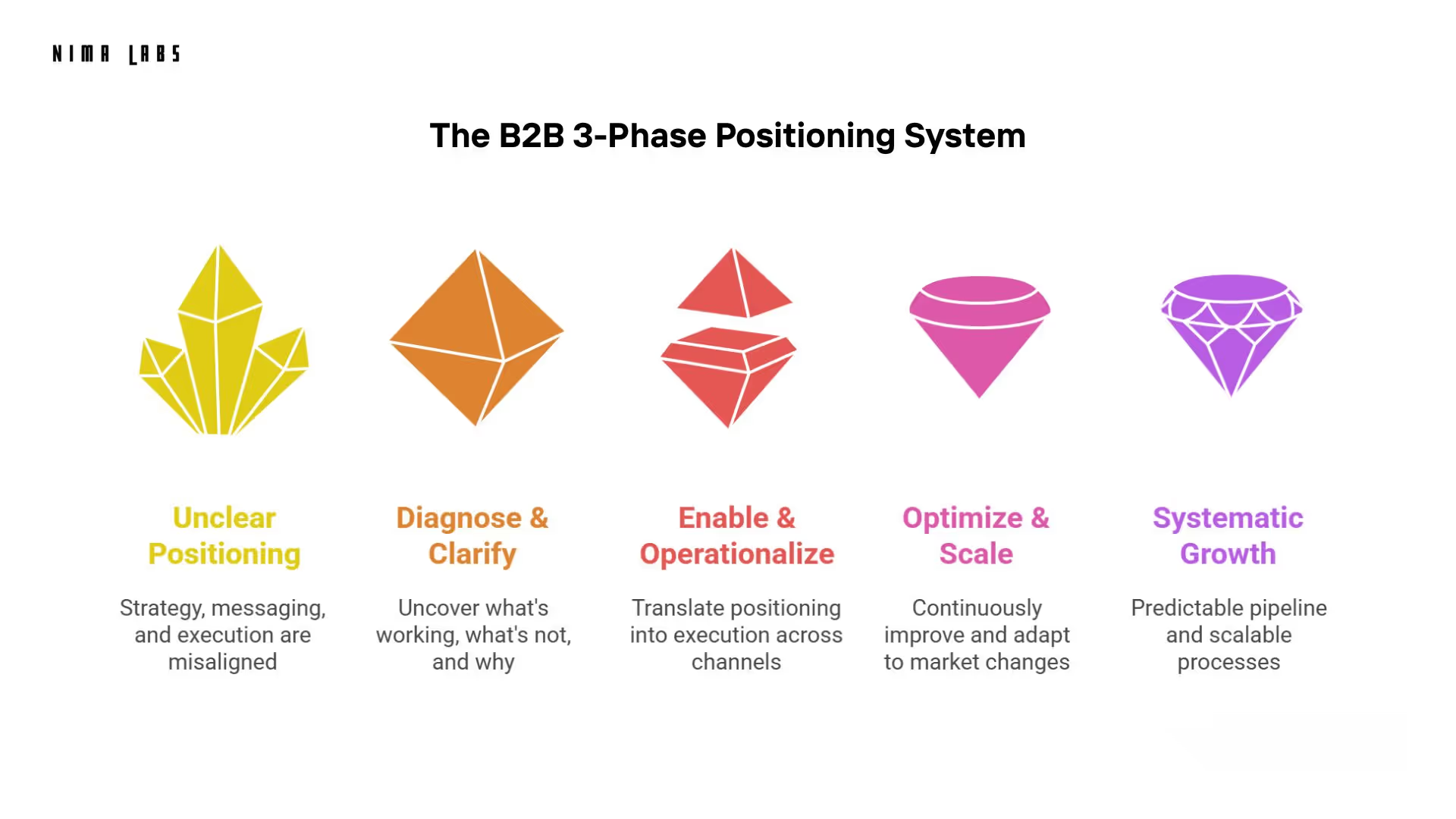
The 3 Phase B2B Positioning System by Nima Labs
5.1 Phase 1 — Diagnose & Clarify
This is where clarity is created.
The diagnostic includes:
Website and funnel audit
ICP and persona analysis
CRM and campaign review
Messaging evaluation
Channel performance review
Interviews with CEO, CMO, Sales, RevOps
The goal: uncover what’s working, what’s not, and why.
Outputs:
A sharpened positioning
A clear value proposition
Defined ICP and personas
A messaging framework
Strategic narrative for all channels
This is the foundation. No funnels, ads, or campaigns should be built before this.
5.2 Phase 2 — Enable & Operationalize
Clarity means nothing if it’s not operationalized.
This phase translates positioning into execution through:
Workshops with leadership & marketing
Messaging and narrative development
Funnel architecture & channel strategy
Campaign concepts
Templates, SOPs, frameworks
CRM + automation setup
Content guidelines and playbooks
The goal: ensure the entire team communicates and acts consistently.
Outputs:
A unified narrative across channels
A functional funnel
Campaigns with clear value messaging
Repeatable workflows
A team that knows exactly what to execute next
This is where positioning becomes a system and not just something you have on paper.
5.3 Phase 3 — Optimize & Scale
Positioning must evolve with the market.
That’s why the system includes continuous optimization:
Pain-Based Value Proposition: Customer language—not internal jargon.
Relevant Differentiators: Not generic claims (“better,” “faster”). Real, provable advantages tied to outcomes.
Messaging Pillars: Three to five strategic pillars that define how you communicate everywhere.
Proof & Credibility: Case studies, metrics, testimonials, data.
GTM Alignment: Marketing, Sales, and Leadership all follow the same narrative and strategy.
Repeatable System: Positioning isn’t static. You must maintain, adapt, and scale it. This is why playbooks, dashboards, and enablement sessions matter just as much as the initial strategy.
7. Before/After: What Changes When Positioning Is Fixed
Strong positioning creates dramatic before/after effects across the entire organization.
BEFORE
AFTER
Marketing runs campaigns, but doesn’t know what message resonates
Messaging becomes clear, simple, repeatable
Sales complains about lead quality
Marketing attracts better leads
The pipeline is unpredictable
Sales converts faster
Internal discussions revolve around tactics, not goals
Funnel metrics improve across every stage
No one can articulate the value clearly
Leadership gains focus and alignment
Website visits are high but conversion is low
Content becomes more relevant, more consistent, more effective
Team works reactively and improvises constantly
The company builds momentum
8. Common Positioning Mistakes B2B Teams Make
Most teams make the same six mistakes—over and over.
Targeting everyone: If you speak to everyone, you resonate with no one.
Leading with features: Customers buy pain relief, outcomes, and clarity—not capabilities.
Confusing complexity with sophistication: If your positioning requires explanation, it’s not positioning.
Copying competitors: Differentiation becomes impossible when your narrative sounds identical to others.
No internal alignment: Different teams pitch different stories. That inconsistency destroys trust and conversion.
No operationalization: A perfect positioning deck that never becomes a funnel, message, or process is worthless.
Avoiding these mistakes alone can transform your go-to-market.
9. How CEOs, CMOs, and Sales Leaders Each Benefit
Positioning is not a marketing luxury. It is a company-wide growth multiplier.
For CEOs:
Clarity in direction and priorities
Predictable pipeline
Strategy that is repeatable, not personality-driven
Better execution and fewer internal debates
For CMOs & Marketing Teams:
Messaging that resonates
Funnels that convert
Structured campaigns and repeatable workflows
Clear KPIs tied to business outcomes
For Sales Leaders:
Better-qualified leads
Consistent narrative
Shorter sales cycles
Improved handovers and alignment
Good positioning reduces friction everywhere.
10. How to Know If Your Positioning Is Broken (Checklist)
Ask your team these questions:
Can everyone explain what we do—in one sentence?
Do our leads match our ideal customer profile?
Are we competing on price more than we should?
Does our content feel repetitive or disconnected?
Does our pipeline fluctuate without clear reason?
Does Sales regularly rework or rewrite Marketing materials?
Do we spend more time discussing tactics than strategy?
If you checked two or more boxes, your positioning is limiting your growth.
11. How Positioning Fits Into a Modern Growth System
Positioning is the first component of a larger growth system:
Positioning
Messaging
Funnel Architecture
Campaign Execution
KPI Tracking
Iteration & Optimization
Without positioning, every element downstream becomes weaker.
With strong positioning, every component becomes more effective—especially when supported by:
automation
a scoring system
content templates
CRM workflows
dashboards
enablement training
Positioning is the strategic input. Execution is the multiplier. Optimization is the engine. Together, they form a growth system that scales predictably.
12. Conclusion: Positioning Is a System, Not a Slogan
Most companies treat positioning as a workshop. The successful ones treat it as an operating system.
Clear positioning gives teams:
focus
direction
alignment
purpose
predictable growth
If your company wants more qualified leads, better conversion rates, shorter sales cycles, and a unified team, you don’t need more campaigns.
You need clarity, structure and positioning system.
Frequently Asked Questions
What is B2B Positioning, and why is it crucial for growth?
B2B Positioning is the strategic choice of who you serve, what problem you solve, and why you solve it better than anyone else. It is defined in the article as the "operating system for growth" because it provides the foundational clarity for every business function, including marketing, sales, and product. Strong positioning is the number one growth lever in B2B because it dictates the entire Go-To-Market (GTM) strategy.
What is the B2B Positioning System (3-Phase Framework)?
The B2B Positioning System is a structured, 3-phase framework for creating and operationalizing clear positioning:
Phase 1 — Diagnose & Clarify: Uncovers what's working and what's not to output a sharpened positioning, clear value proposition, and a messaging framework.
Phase 2 — Enable & Operationalize: Translates the positioning into execution through funnel architecture, campaign concepts, repeatable workflows, and internal team workshops.
Phase 3 — Optimize & Scale: Ensures positioning evolves with the market through continuous KPI tracking, performance reviews, and messaging adjustments to create a self-improving growth engine.
What are the 7 Elements of Effective B2B Positioning?
High-performing B2B companies consistently incorporate these seven structural elements:
Pain-Based Value Proposition: Communicating in customer language, focusing on outcomes and pain relief.
Relevant Differentiators: Real, provable advantages tied to specific outcomes.
Messaging Pillars: Three to five strategic pillars for consistent communication across all channels.
Proof & Credibility: Utilizing case studies, metrics, testimonials, and data.
GTM Alignment: Ensuring Marketing, Sales, and Leadership follow the same narrative.
Repeatable System: Maintaining, adapting, and scaling the positioning over time with playbooks and dashboards.
How do I know if my company's B2B positioning is broken or limiting growth?
The article provides a checklist. Your positioning is likely broken if you check two or more of the following:
Sales regularly reworks or rewrites Marketing materials.
Your leads do not match your Ideal Customer Profile (ICP).
Your pipeline fluctuates without a clear reason.
You are competing on price more than you should.
No one on the team can articulate your value clearly in one sentence.
What is the difference between Positioning, Messaging, and a USP?
They are distinct strategic components:
Positioning is the strategic choice and defining the truth you communicate (the "operating system for growth").
Messaging translates the strategic positioning into the actual words used in pitches, content, and campaigns.
USP (Unique Selling Proposition) is just one differentiator; positioning is the whole system encompassing the market, segment, problem, value, proof, and narrative.