
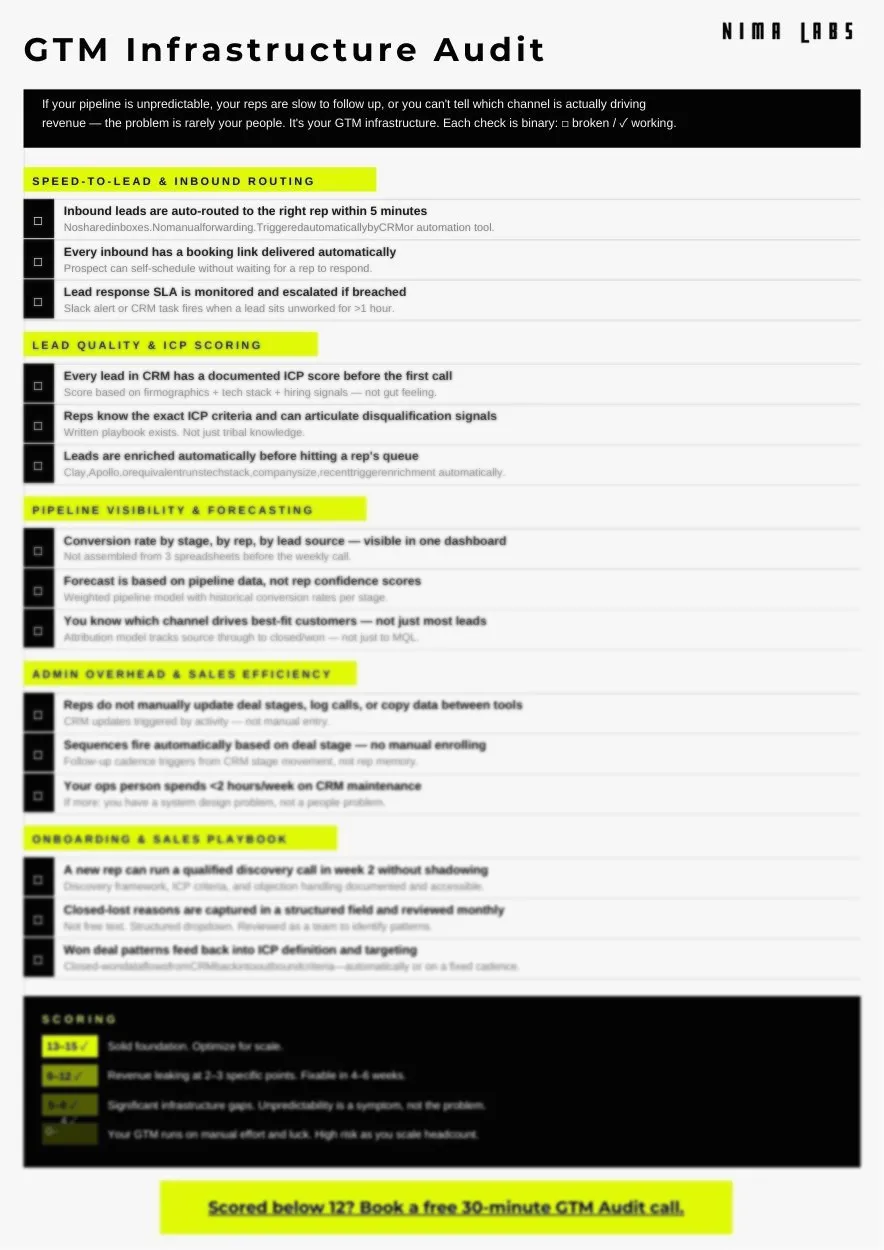

TL;DR: Why speed to lead is a marketing infrastrcuture problem
When inbound leads go cold, the blame lands on sales. But every step between form submit and first human contact — routing logic, enrichment, booking flow, notification setup — is marketing infrastructure. Marketing owns it. The failure stays invisible in most CRMs because leads that never get worked don't show up as lost. Fixing it is not an SLA policy. It is building the infrastructure so qualified leads never wait more than 5 minutes, regardless of who is in a meeting.
When a qualified inbound lead goes cold, the post-mortem almost always points at sales. Slow follow-up. No urgency. Reps not checking the shared inbox. The fix proposed is usually a process reminder, a Slack message to the team, or a new SLA policy that lives in a Google Doc and gets ignored within two weeks.
The problem with this diagnosis is that it's wrong. Not partially wrong. Structurally wrong.
The failure happens before sales ever sees the lead. It happens in the 4-hour window after the form submit, inside marketing infrastructure that marketing built, owns, and is responsible for maintaining. Blaming sales for slow follow-up when the routing logic is broken is like blaming a driver for missing a turn that wasn't on the map.
The Blind Spot That Makes This Speed-to-Lead Problem Invisible
Here is the specific reason this keeps going undiagnosed: deals lost to slow inbound lead response time don't show up in the CRM as lost deals.
When a prospect submits a demo request on Tuesday afternoon and gets a reply 48 hours later, two things typically happen. Either they've already booked a call with a competitor. Or they've moved on mentally and the call they eventually take is low-commitment, unfocused, and easy to ghost.
In both cases, what the CRM records is a contact that never got worked or a deal archived as "unresponsive prospect." Neither shows up as a loss caused by slow response. The failure never feeds back into marketing's attribution model or the campaign performance report that drives next quarter's budget decisions.
Marketing sees "form submitted" in HubSpot. The lead count goes up. Conversion to MQL gets credited. The campaign looks healthy.
Meanwhile, somewhere in a shared inbox, a Slack channel, or a HubSpot queue that three people technically own and nobody actively monitors, the lead is waiting. And then it stops waiting, because the prospect moved on.
This is the attribution blind spot that keeps speed to lead invisible as a marketing infrastructure problem. The metric that would reveal the failure (time from form submit to first meaningful contact) is either not tracked at all or not connected back to campaign performance. Marketing optimizes the front of the funnel and calls the job done at form submit. The leak is further downstream, but it drains the same budget.
Where the Inbound Lead Response Time Failure Actually Happens
The 4-hour window after a form submit is where inbound pipeline is made or lost in any competitive B2B SaaS market. The research on this is consistent and has been for years: response within 5 minutes produces dramatically higher qualification rates than response within an hour, and response within an hour is dramatically better than response the next morning. This is not about sales urgency. It is about buyer psychology. The prospect's intent is highest at the moment of form submit. It degrades fast.
So what happens in that 4-hour window inside most B2B SaaS companies?
The form submits. The lead lands somewhere — a HubSpot inbox, a shared sales@company email, a Slack notification that fires to a channel — and sits there waiting for a human to notice it, decide it's qualified enough to act on, figure out whose job it is, and reach out. If it's Tuesday at 4pm, that might happen. If it's Friday at 5pm, it probably doesn't happen until Monday, at which point the window has been closed for 60 hours.
Even when someone responds quickly, the rep calls with no context — a name, a company, maybe a job title. The first 10 minutes of a discovery call get spent gathering information that should have been gathered automatically before the lead touched a human.
And before any of this happens, there's the booking form itself. A prospect who clicks "Request a Demo" and hits a 9-field form asking for company size, revenue range, current tooling, and how they heard about you has already started losing interest. Every field is a micro-friction point. Every additional question is an implicit message: we're not sure you're worth our time yet, so prove it. Some percentage of intent drops off before the form completes. That percentage is invisible to marketing, because an abandoned form generates no record.
All of this is marketing infrastructure. All of it is marketing's domain.
Why Speed to Lead Sits in Marketing's Lane
There is a version of this conversation where the blame stays vague — "it's a cross-functional problem" or "sales and marketing need to align." That framing is accurate but useless. It doesn't assign ownership, and without ownership nothing changes.
The lead routing automation that determines where a lead goes after form submit was set up by whoever built the HubSpot workflow. That's marketing, or marketing ops, or a RevOps person who reports up through marketing. The enrichment layer (if it exists) that appends tech stack and company size and ICP fit score before the lead touches a rep was either built by marketing or never got built at all. The booking form and the number of fields on it was a marketing decision. The SLA that specifies how quickly a lead needs to be worked was either written by marketing ops or it doesn't exist. The Slack notification that fires when a high-intent lead comes in was either configured by marketing or it wasn't set up.
Every single point in the chain between form submit and first human contact is a marketing infrastructure decision.
This matters because it determines where the fix needs to happen. If the problem is sales execution, the fix is sales coaching, incentive restructuring, or hiring. If the problem is marketing infrastructure, the fix is routing logic, enrichment setup, and booking flow design. These are completely different interventions. Getting the diagnosis wrong means applying the wrong fix and wondering why nothing changes.
A team that keeps optimizing LinkedIn campaigns and Google Ads while the infrastructure between the form submit and the sales call is broken is filling a leaky bucket from the top. The bucket looks fuller, the campaigns get credit, and the pipeline quality stays exactly where it was.
The Cost of Slow Inbound Lead Response Time in Concrete Terms
Abstract percentages don't make this real. So make it concrete.
Three qualified inbound leads come in on a Tuesday. A Head of Demand Gen at a $5M ARR SaaS company, a Growth Lead at a B2B FinTech, and a Marketing Ops Manager who has been tracking the company for six months and finally hit the "Request a Demo" button. Each of them is a real opportunity. Each of them is, by any reasonable ICP definition, the kind of lead that justifies the €8,000 in paid spend that generated them this month.
None of them get a response within 4 hours.
Not because the sales team is incompetent. Because nobody is monitoring the shared inbox on Tuesday afternoon, the HubSpot notification fired to a Slack channel that two reps have muted, and the rep who would normally own these leads is in back-to-back calls until 5pm. By the time anyone sees the leads, it's Wednesday morning.
One of the three books a call, takes it, and ends up ghosting after the second email. One responds to the Wednesday morning outreach with "I actually went with someone else." One never replies.
This is a €16,000-plus pipeline problem (assuming even a modest average deal size) that will not show up anywhere in marketing's reporting as a speed-to-lead failure. The campaigns will look fine. The CRM will show three leads that didn't convert. The post-mortem, if it happens at all, will be vague.
The lead routing automation that could have connected those three leads to a rep within 5 minutes, appended ICP context before the first call, and sent an automated booking confirmation while the rep was still in their last meeting — that infrastructure either doesn't exist or was never connected to the form.
That's not a sales problem. That's the system not doing what it was supposed to do.
What Fixing Speed-to-Lead Marketing Infrastructure Actually Looks Like
The fix is not a new SLA policy. It's not a Slack message to the sales team asking them to be more responsive. Those are management interventions on top of broken infrastructure, and they work for about two weeks.
The fix is building the routing, enrichment, and booking infrastructure so that a qualified lead never waits more than 5 minutes for a next step — without that depending on any individual human's availability at any specific moment. The form submits. The lead gets scored against ICP criteria automatically. A booking link goes out within 2 minutes. A rep gets a Slack notification with enriched context before they pick up the phone. The marketing infrastructure handles the handoff. The human handles the conversation.
Speed to lead: The time between a prospect's first inbound action (form submit, demo request, content download) and the first meaningful response from the revenue team. In competitive B2B markets, every minute past the 5-minute mark measurably reduces qualification rates.
This is buildable. The tools exist: Make.com for lead routing automation, Clay for enrichment, HubSpot for lifecycle management, and any modern calendar tool for frictionless booking. The architecture is not complex once it is designed correctly.
The question is not whether to build it. It is knowing where in your specific setup the chain is already breaking — because it is almost never broken in one place. Most teams have a combination of a routing gap (nobody owns the workflow), an enrichment gap (leads arrive context-free), and a friction gap (the form kills conversion before sales ever sees the lead). Fixing one without diagnosing all three produces a partial improvement that still leaks pipeline in the other two places.
If you are reading this and recognizing the pattern — campaigns performing, pipeline underperforming, and the default explanation being "sales needs to close better" — that is a speed-to-lead marketing infrastructure problem. The Phase 1 Marketing Infrastructure Audit maps where your specific chain is breaking, before you spend another quarter optimizing the front of the funnel without fixing what comes after it.
Frequently Asked Questions
What is speed to lead in B2B marketing? Speed to lead is the elapsed time between a prospect's first inbound action (form submit, demo request, content download) and the first meaningful response from the revenue team. In B2B SaaS, response within 5 minutes produces significantly higher qualification rates than response within an hour. Beyond an hour, intent has already degraded.
Why does slow inbound lead response time not show up in CRM reporting? Because CRM systems record what was worked, not what was lost before anyone acted. A lead that goes cold after a 48-hour delay gets recorded as "unresponsive" or archived with no activity — not as a loss caused by slow response. The failure is invisible to attribution models, so marketing keeps optimizing campaigns while the downstream leak continues.
Is lead routing automation difficult to set up? No. The core stack (Make.com for routing logic, Clay for enrichment, HubSpot for lifecycle management, and a calendar tool for booking) covers most of the architecture. The difficulty is not the tooling. It is diagnosing exactly where the current handoff chain is breaking before building the fix on top of a misunderstood problem.
Whose responsibility is speed to lead — marketing or sales? Every step between form submit and first human contact is a marketing infrastructure decision: the routing workflow, the enrichment layer, the booking form design, the SLA configuration, and the notification logic. Sales owns the conversation. Marketing owns the chain that delivers a qualified, context-rich lead to that conversation within 5 minutes.
What does poor speed to lead actually cost?The cost is pipeline that disappears before it is ever counted as lost. A single week of slow routing at a company spending €8,000/month on paid acquisition can represent €16,000 or more in untracked pipeline loss — deals that never make it to the CRM as active opportunities because the response window closed before anyone picked them up.